Roots Reclaimed — Mini Documentary
This documentary was produced as a senior capstone project at Hampton University by Simone Octavia Stephen, Class of 2026.
📍 Hampton Roads, Virginia
🎓 Hampton University | Journalism Capstone 2026
ROOTS RECLAIMED follows three Black farmers in Hampton Roads, Virginia — Thelonious Cook of Mighty Thundercloud Farm, Sharon Creekmore Moseley of Creekmore’s Place, and Dee Hall Goodwin of Mermaid City Flower Farms — as they tend the land, build community, and reclaim a legacy that was never meant to be forgotten.
This documentary was produced as a senior capstone project at Hampton University by Simone Octavia Stephen, Class of 2026.
📍 Hampton Roads, Virginia
🎓 Hampton University | Journalism Capstone 2026
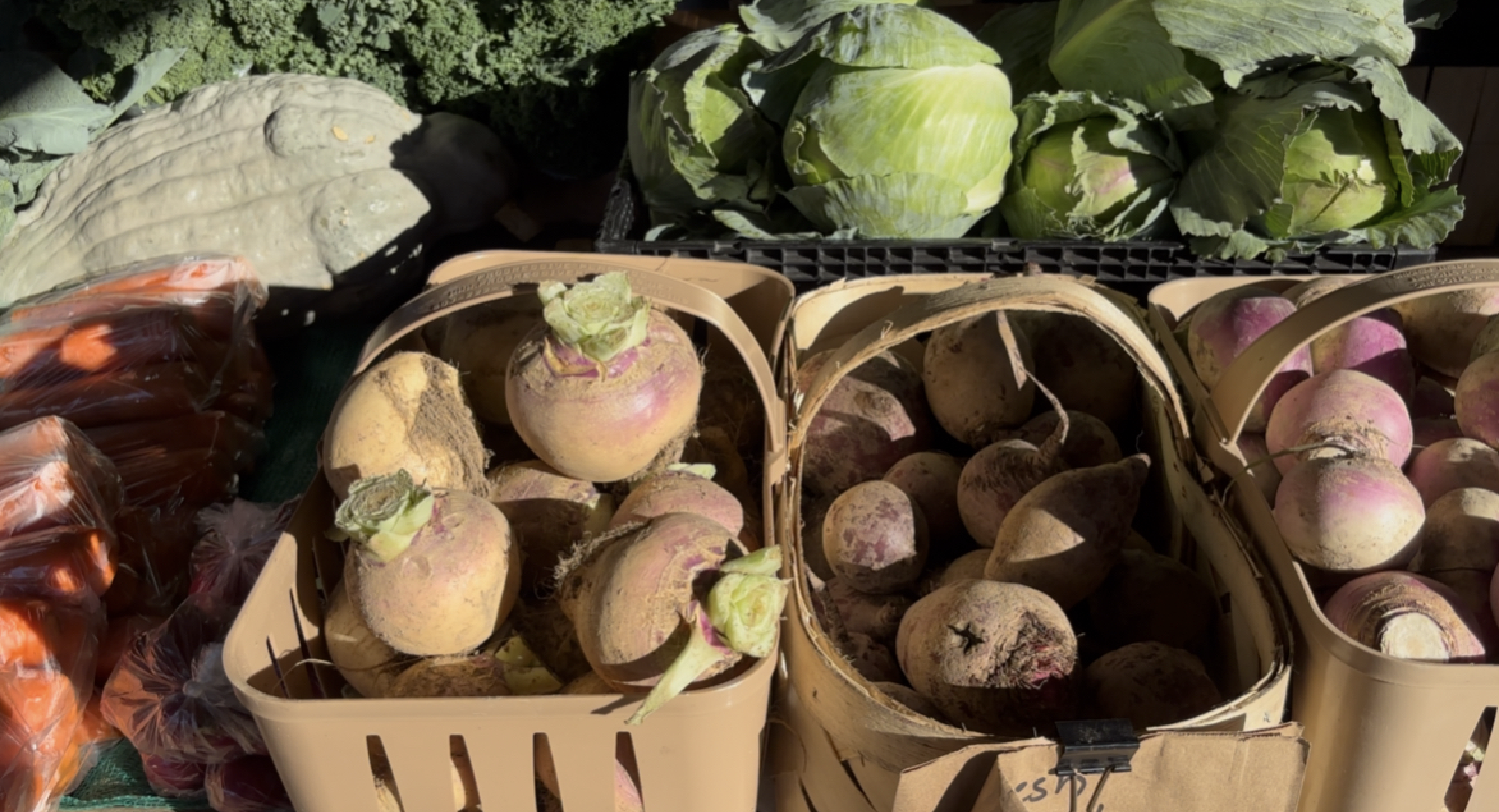
Roots Reclaimed - Editorial Photo Spread
A visual look into the farmers, markets, land, and community shaping the Black agricultural revival in Hampton Roads.
A visual look into the farmers, markets, land, and community shaping the Black agricultural revival in Hampton Roads.


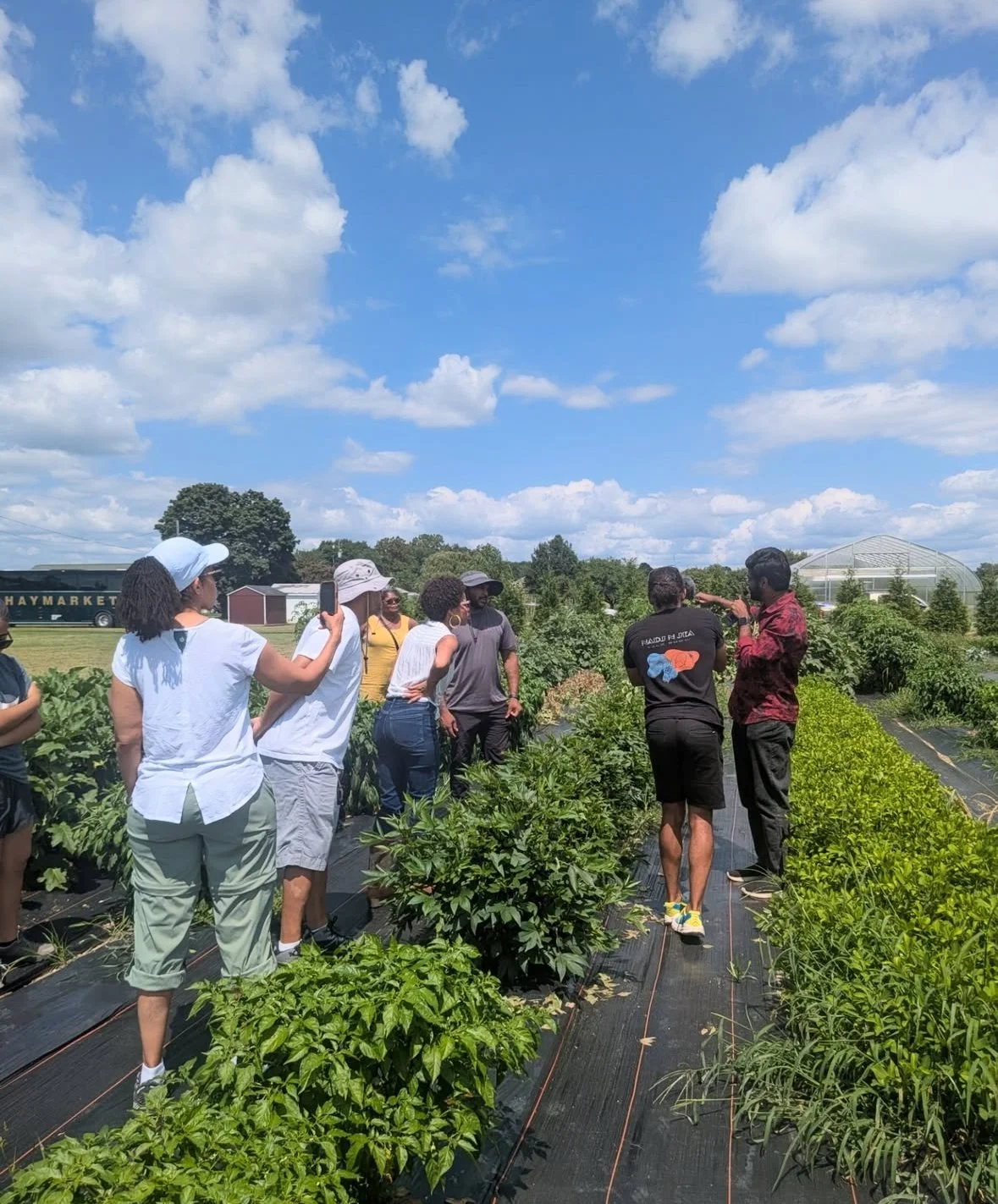
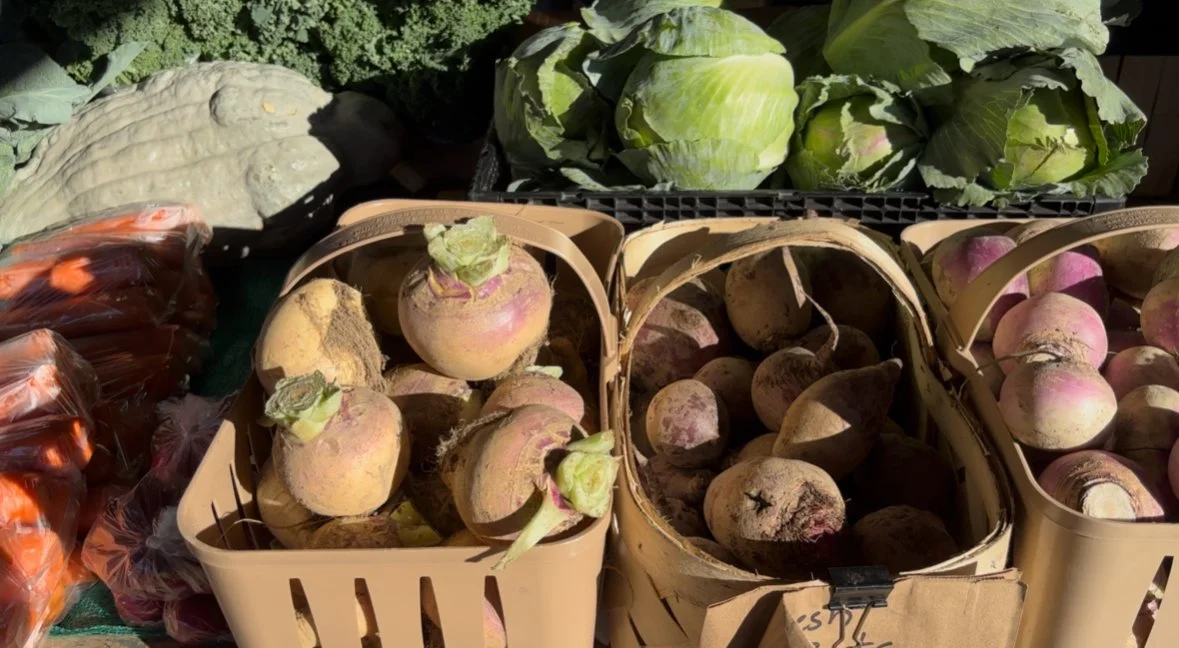

Roots Reclaimed — Video Podcast Episode
Roots Reclaimed is a video podcast exploring the past, present, and future of Black farming in southeastern Virginia. Through intimate conversations and on-the-ground visuals, host Simone Octavia Stephen spotlights the farmers, growers, and land stewards working to restore community, rebuild food access, and reclaim a legacy nearly erased. This episode blends storytelling, history, and lived experience to reveal why returning to the land still matters today.
Roots Reclaimed is a video podcast exploring the past, present, and future of Black farming in southeastern Virginia. Through intimate conversations and on-the-ground visuals, host Simone Octavia Stephen spotlights the farmers, growers, and land stewards working to restore community, rebuild food access, and reclaim a legacy nearly erased. This episode blends storytelling, history, and lived experience to reveal why returning to the land still matters today.
ROOTS RECLAIMED
“Roots Reclaimed” is a look into the farmers who are healing land, feeding communities, and rebuilding a legacy nearly lost. Their work is more than farming; it’s reclamation, resilience, and resistance.
Black Farmers Restoring Land, Legacy, and Community in Hampton Roads
By Simone Octavia Stephen | Hampton University
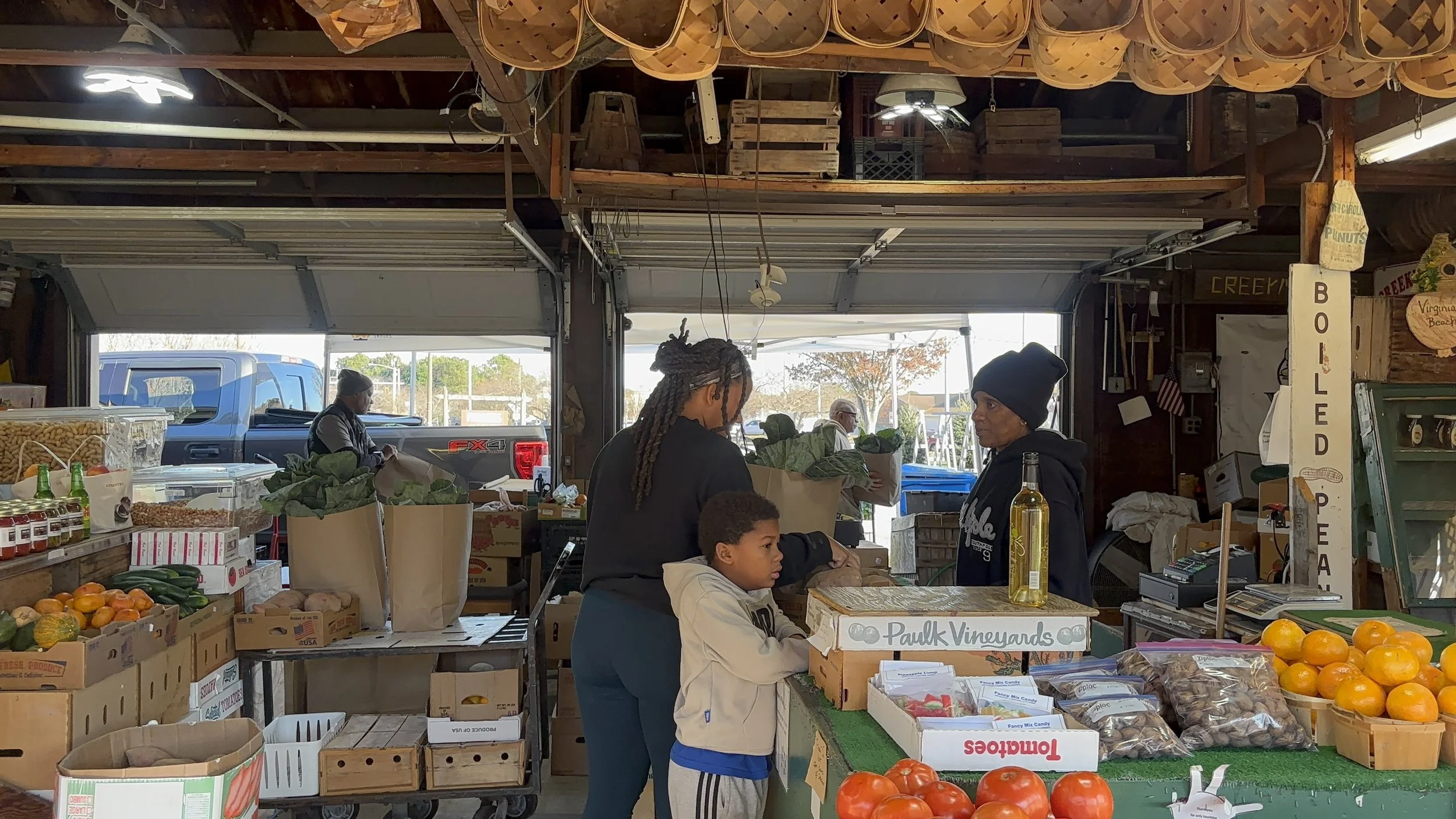
The line forms early at Creekmore’s Place.
Before the folding tables are set up, before crates of collards, tomatoes and sweet potatoes are arranged beneath the tent, customers are already waiting — some with reusable bags, others with questions or stories about the farms they once knew.
For Sharon Creekmore Mosley, the steady stream of people who arrive each week at her Virginia Beach stand is more than business. It is a community.
“There are very few of us left. When people see a Black farmer, they stop. They want to talk. They want to reconnect.” — Sharon Creekmore Mosley
In a region where Black-owned farms were once common, Mosley is now part of a shrinking group. Across Hampton Roads, a small network of Black farmers is working against economic pressure, land loss and industry barriers to rebuild agricultural knowledge and reclaim access to the soil.
Their presence challenges more than a century of decline in Black farming nationwide — but it also reflects a quiet resurgence: a new generation returning to the land in both traditional and unconventional ways.
“It Still Means Something”
Mosley farms the same land her grandparents and father once tended — property now surrounded by new housing developments and widened roads. As a child, she watched her father farm in the afternoons after working overnight shifts as a longshoreman.
“My grandparents started farming before I was born,” she said. “This is what our family has always done.”
Today, Mosley grows vegetables and herbs, sells weekly at local markets and spends much of her time answering questions from customers who want to understand how their food is grown.
“People want transparency,” she said. “Some older customers come because they remember what farming looked like here. Younger families come because they want their kids to know.”
More than once, Mosley paused during conversation to greet customers by name. Many have been visiting her stand for years.
“That connection is important. We do this because it still means something — for us and for the community.” — Sharon Creekmore Mosley
Finding Freedom in the Soil
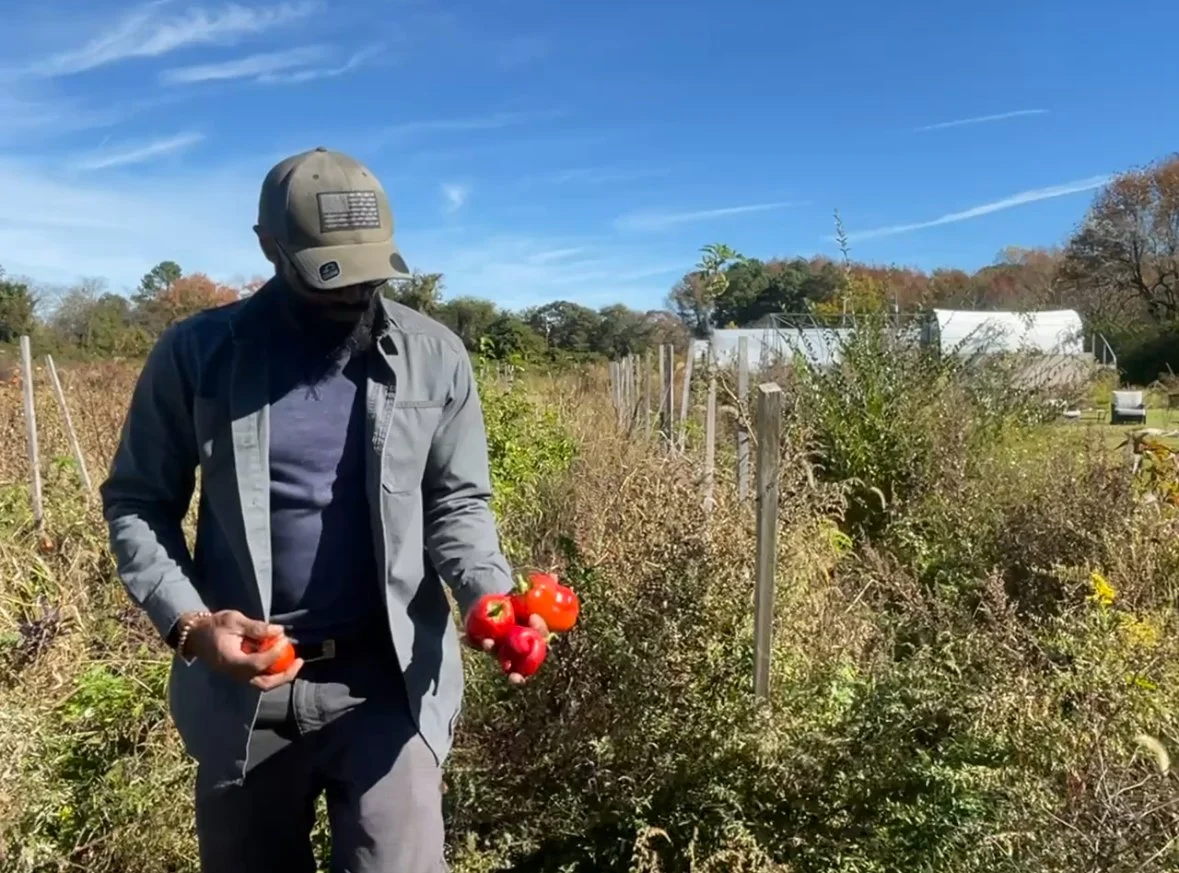
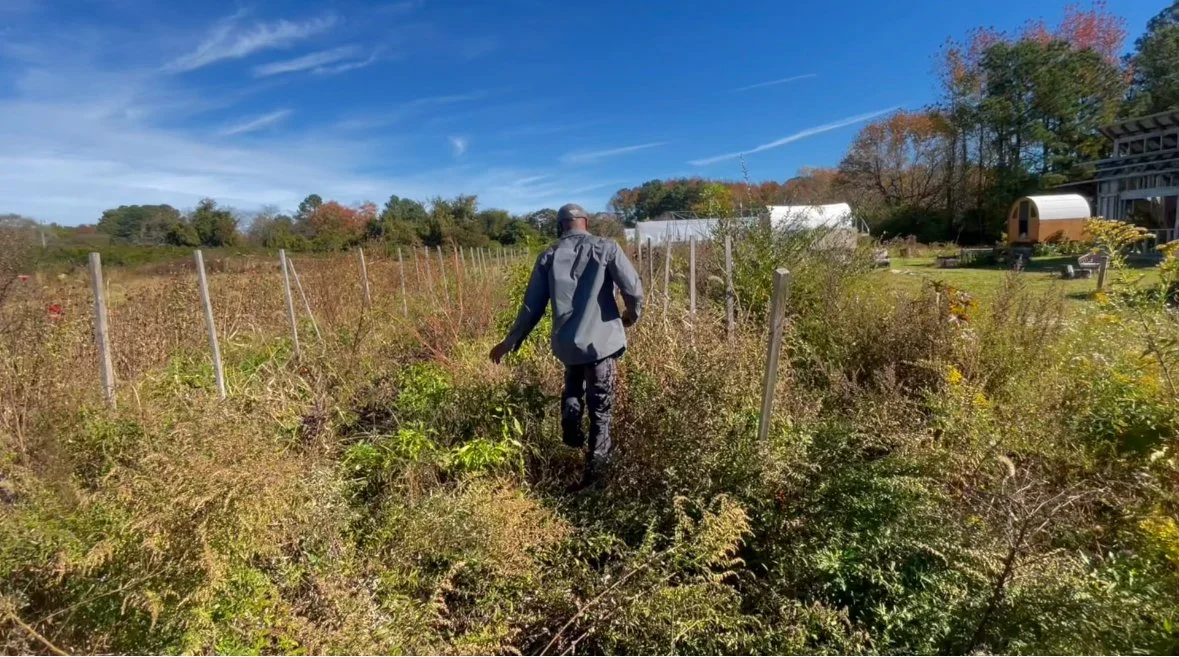
An hour north, on Virginia’s Eastern Shore, Thelonious Cook walks the length of Mighty Thundercloud Farm as wind moves through rows of hibiscus, greens and herbs. His farming journey, he insists, began accidentally.
“I didn’t plan to farm,” he said, laughing. “Not even a little.”
After graduate school, Cook spent a year living in a rural agricultural village in Tanzania. When he returned to Virginia, he learned his family needed help managing inherited land that had become overgrown. He went to clear it out, just to help. But something changed.
“At that time, I fell in love with being on the land,” he said.
What began as a small garden grew into a full-scale operation. Cook first produced food for himself, then for his family and eventually for customers. Ten years later, Mighty Thundercloud Farm is both a working farm and a community learning space focused on culturally rooted crops and land stewardship.
“Being a Black farmer here carries historical weight. This is where the first Africans were brought. Agriculture is part of our lineage.” — Thelonious Cook
Cook hosts workshops on composting, herbalism and regenerative practices. During the pandemic, he saw interest surge.
“People felt vulnerable,” he said. “Grocery shortages, high prices, uncertainty. Growing even a little food makes people feel powerful again.”
His mission has expanded beyond production.
“My goal became to create a safe space,” he said. “A place where people can reconnect — to the land, to themselves, to something larger.”
Farming Without Acreage: An Urban Model in Norfolk
In Norfolk, the idea of a traditional farm doesn’t apply. For urban flower farmer Dee Hall Goodwin, owner of Mermaid City Flowers, agriculture is mapped across small pockets of the city: backyard corners, condo courtyards and unused residential side yards.
Her approach — community land sourcing — began when she couldn’t find locally grown flowers for her own wedding.
“That surprised me,” she said. “With all the agriculture in this region, there were no cut-flower farms.”
So she created one.
Today, Goodwin tends multiple microplots across Norfolk. Each plot has its own microclimate, allowing her to grow thousands of tulips, dahlias, ranunculus and native flowers each year. She designs wedding florals, runs a studio and manages day-to-day farm work.
“Every day is different,” she said. “A little planting, a little designing, a little administrative work. It depends on the season.”
Goodwin is also a regional and national leader. She founded the Tidewater Flower Collective, a cooperative of about 25 local growers who share supplies, troubleshoot crop issues and support one another’s markets. She also founded Black Flower Farmers, an international group of more than 50 Black growers in an industry where representation is scarce.
“There might be only around a hundred Black flower farmers in the U.S. It’s a very small community.” — Dee Hall Goodwin
Sustainability anchors her work. She avoids pesticides, makes her own compost from bagged leaves gathered around Norfolk, uses rainwater for irrigation and refuses to use floral foam, which contains microplastics.
“Flowers are the medium. The message is community and sustainability.” — Dee Hall Goodwin
Her work shows that land stewardship doesn’t require acreage. Only intention, creativity and collaboration.
A Decline Rooted in History
Though the farmers’ stories drive this resurgence, the challenges they face have deep historical roots.
In 1920, Black farmers made up 14% of all U.S. farmers. Today, they account for less than 2%. Between 1910 and 1997, Black farmers lost 90% of their farmland nationally, according to the USDA. In Virginia, recent agricultural census data shows fewer than 400 Black farmers statewide.
The decline stems from federal discrimination — Black farmers were routinely denied USDA loans or faced delayed approvals that cost them entire growing seasons. Heirs’ property laws allowed any heir to force a sale of inherited land, often resulting in the loss of generational property. And urban expansion across Hampton Roads steadily reduced available farmland.
Across the region, that history is visible in the landscape: shrinking acreage, limited access to capital and the near-disappearance of multigenerational Black-owned farms.
Signs of a Return
Despite these barriers, farmers across the region say they are witnessing renewed interest.
Mosley sees young families at her stand asking how to grow tomatoes. Cook sees students leave Mighty Thundercloud Farm inspired to start container gardens. Goodwin sees more growers joining her collectives each year.
“There’s community again,” Goodwin said. “People are sharing information. That matters.”
For Cook, the return is also emotional.
“They come here and remember something,” he said. “A smell, a memory, a grandparent’s garden. They reconnect.”
The resurgence is small but significant — a reminder that Black farming never disappeared entirely. It adapted, shifted and endured.
Reclaiming More Than Land
Mosley preserves a family legacy. Cook builds a path toward self-reliance and community healing. Goodwin reimagines farming in dense urban spaces and uplifts growers nationwide.
Together, they represent a new chapter of Black agriculture in Hampton Roads — one defined not by loss, but by reclamation.
Their farms are more than fields or flower beds. They are classrooms, gathering spaces, cultural archives and, for many, a way back to something almost forgotten.
“Black farmers in Hampton Roads are not disappearing. They are returning.”
Plot by plot, seed by seed, story by story, they are rebuilding a future where the past is honored and carried forward. Where agriculture is not a relic but a lifeline. Where the soil is not just dirt, but history, identity and possibility.